
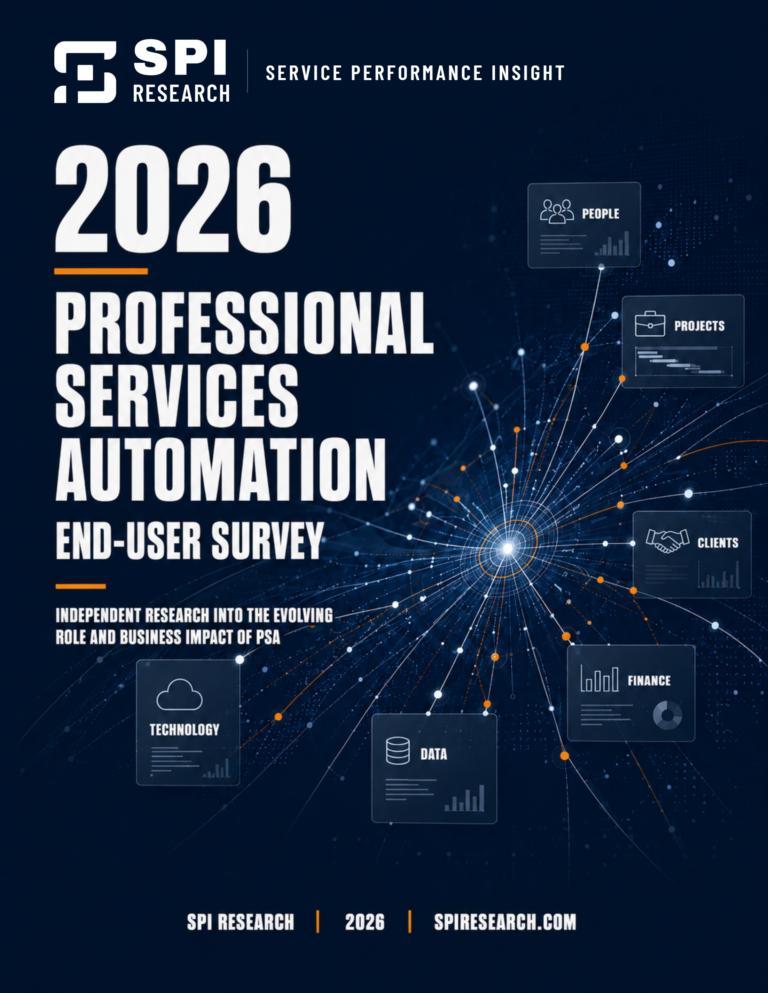
About the 2026 PSA End-User Survey Report
SPI Research’s 2026 Professional Services Automation (PSA) End-User Survey provides an independent view of how professional services organizations are using PSA today, the operational value they are achieving and how expectations of PSA platforms are evolving.
Based on 101 respondent records, including 88 current PSA users, the research examines PSA adoption and business coverage, enterprise integration, user satisfaction, embedded artificial intelligence, operational performance and return on investment.
The research points to a market at an important transition point. PSA remains the operational system of record for project- and services-driven work, but leading organizations are extending it into a broader system of intelligence for forecasting, resource decisions, delivery control, financial governance and increasingly AI-assisted action.
Why this report matters
Professional services organizations are under constant pressure to balance growth, talent costs, delivery predictability, project economics and cash performance. At the same time, leaders are being asked to make faster decisions across increasingly complex and distributed services businesses.
PSA sits at the centre of this operating challenge. What began primarily as a way to manage projects, resources, time and expense has evolved into an operational backbone connecting demand, staffing, delivery, financial performance and business planning.
The next stage of PSA is now emerging. Greater integration, stronger analytics and embedded AI are creating the potential for PSA to move beyond recording what has happened towards helping organizations anticipate risk, forecast demand, optimize resources and guide operational decisions.
The 2026 research shows, however, that technology alone does not determine success. The value organizations achieve from PSA increasingly depends on how broadly it is used, how well it is integrated, the quality of the underlying data and the level of executive and management commitment behind it.
What the 2026 research reveals
The 2026 PSA End-User Survey captures a market undergoing significant change. PSA remains fundamental to the management of project- and services-driven organizations, but expectations of these platforms are expanding rapidly.
The research examines several important shifts shaping the next generation of PSA:
- The changing role of PSA as organizations extend its use beyond project administration into broader operational planning, forecasting and decision-making.
- Where organizations are achieving the greatest operational benefits and which areas continue to offer unrealized potential.
- How PSA buying priorities are changing, including the growing importance of resource intelligence, integration, analytics and usability.
- The state of enterprise integration, and where disconnected systems continue to limit visibility across sales, talent, delivery and finance.
- How AI is beginning to reshape PSA, including where organizations are experimenting today and how far the market has progressed toward predictive and AI-assisted operations.
- What separates organizations achieving greater value from PSA from those struggling to translate technology investment into measurable business improvement.
The report combines current 2026 findings with SPI Research’s previous PSA End-User studies to show not only where the market stands today, but how PSA priorities, capabilities and business outcomes have changed over time.
What’s inside the report
The 2026 PSA End-User Survey Report provides a detailed, evidence-based view of how professional services organizations are selecting, using and deriving value from Professional Services Automation.
The report includes analysis of:
- PSA adoption and market maturity – including how long organizations have used PSA and how extensively it supports the services lifecycle.
- Buying priorities and solution requirements – what organizations expect from PSA today, why they invest and which capabilities matter most.
- PSA module priorities and user satisfaction – how users rate the core capabilities, technology, usability, analytics, implementation experience and value delivered.
- Enterprise integration and governance – the relationship between PSA and financial, CRM, HCM and business-planning systems, together with the role of executive commitment.
- Embedded AI in PSA – a new 2026 analysis of AI capability, adoption, maturity, perceived value and expectations for AI-assisted services operations.
- Operational performance before and after PSA deployment – examining the impact across resource utilization, project delivery, margin, revenue leakage, invoicing and cash collection.
- How PSA has evolved since 2017 and 2022 – using comparable measures from SPI Research’s previous PSA End-User studies to identify long-term shifts in priorities and outcomes.
- PSA return on investment – including a structured economic model examining the potential financial value and payback associated with PSA.
- Conclusions and executive recommendations – translating the research into practical priorities for professional services leaders, PSA owners, finance, resource management and technology teams.
Who should read this report?
The 2026 PSA End-User Survey is designed for leaders responsible for improving the performance of project- and services-driven organizations, including:
- Professional services executives and business leaders looking to improve growth, profitability, visibility and operational performance.
- Services operations and resource management leaders responsible for capacity, utilization, forecasting, staffing and project delivery.
- Finance and commercial leaders seeking greater control over project economics, revenue leakage, invoicing, cash flow and margin.
- Technology, systems and PSA owners evaluating platform strategy, integration, data quality, analytics and the emerging role of AI.
- Organizations evaluating or replacing PSA technology that want independent insight into current buyer priorities, capabilities and expected business outcomes.
- PSA software providers and technology partners seeking an independent view of how customer requirements and the wider PSA market are evolving.
Whether you are optimizing an existing PSA environment, considering a new platform or developing your services operating model, the report provides an independent benchmark against which to assess your priorities and investment decisions.
Access the 2026 PSA End-User Survey Report
Gain access to SPI Research’s complete 2026 analysis of the Professional Services Automation market, including detailed benchmark data, historical comparisons, operational performance analysis, AI maturity findings, return-on-investment modelling and executive recommendations.
2026 Professional Services Automation End-User Survey Report
Published: August 2026
Format: Digital PDF
Price: $795
Survey participants who qualify for a complimentary copy of the research will receive separate access directly from SPI Research.
About the research
The 2026 PSA End-User Survey is the latest in SPI Research’s long-running examination of Professional Services Automation and how it affects the performance of project- and services-driven organizations.
The study contains 101 respondent records, with 88 current PSA users forming the principal analytical sample. It examines PSA adoption, buying priorities, module importance, integration, satisfaction, embedded AI and operational performance across the services lifecycle.
SPI Research applied a rigorous analytical methodology to the 2026 data. Performance comparisons use matched pre- and post-PSA observations and report-critical measures were independently calculated from respondent-level survey data.
Where questions remain comparable, the 2026 results are also examined alongside SPI Research’s 2017 and 2022 PSA End-User studies, providing a longer-term view of how PSA priorities, capabilities and business outcomes are evolving.
Explore the full 2026 findings
Access the complete 2026 PSA End-User Survey Report for the detailed benchmarks, analysis and recommendations behind the research.
$795 | Digital PDF
For more information, please contact info@spiresearch.com.