
Professional Services Maturity Model
SPI Research’s Professional Services Maturity Model™ helps professional services organisations benchmark performance, identify operational gaps and improve profitability using 19 years of data-driven insight.

The Professional Services Maturity Model™
A practical framework for benchmarking and improving professional services performance
SPI Research developed the Professional Services Maturity Model™ as a strategic planning and management framework for professional services organizations. The model helps PS leaders assess operational maturity, compare performance against peer benchmarks and identify the actions required to improve growth, profitability and service execution.
The framework is now used by over 50,000 service and project-oriented organizations to understand current performance, prioritize improvement opportunities and chart a clearer course to service excellence.
SPI’s latest PS Maturity Benchmark™ report includes more than 200 pages of data-driven insight, framed around the PS Maturity Model™.
The core tenet of the PS Maturity Model™ is that PSOs can improve performance through the optimization of five Service Performance Pillars™:
- Leadership
- Client Relationships
- Talent
- Service Execution
- Finance & Operations
The Professional Services Maturity Model™ is designed to help Professional Service Organizations (PSOs) understand their relative performance compared to an expansive benchmark of peers. It provides visibility into critical business processes and key performance measurements so organizations can compare, diagnose and improve their own performance. It also provides prescriptive advice so organizations can pinpoint current levels of maturity and visualize the steps required to advance to the next level. Not least, it enables PS leaders to understand benchmark standards for such metrics as average PS employee billable utilization, project margin, AI adoption, and 150+ other KPIs core to running a modern PSO efficiently..
Simply put – we identify what it takes for you to be great from the most expansive professional services industry data-set.
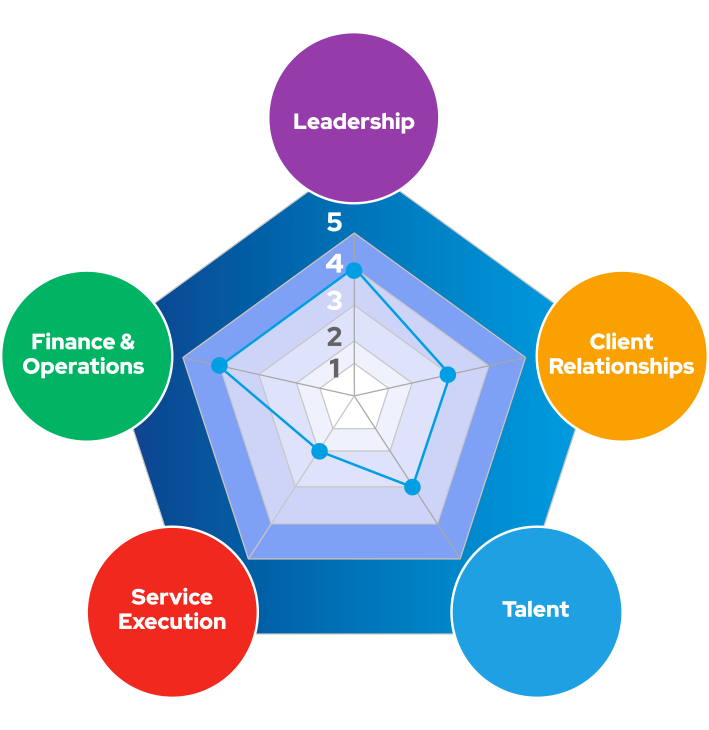
The five pillars of the Professional Services Maturity Model™
The Professional Services Maturity Model™ evaluates performance across five Service Performance Pillars™. Together, these pillars help PS leaders assess strategy, client relationships, talent, service execution, financial performance and operational maturity.
Leadership

Vision, Strategy and Culture
The ability to set direction, align the organization and create the leadership discipline needed to improve professional services performance.
Client
Relationships

Marketing and Sales
The ability to generate demand, win the right opportunities, retain clients and expand profitable relationships.
Talent

Talent Management
The ability to attract, hire, develop, deploy and retain high-quality professional services talent.
Service
Execution

Engagement and Delivery
The methodologies, processes and tools used to scope, schedule, deliver and measure service quality.
Finance and Operations

Finance And Operations
The ability to manage revenue, margin, utilization, billing, forecasting and operational controls.
Service Maturity Levels
Within each Service Performance Pillar™, SPI Research has developed key performance measurements and maturity level definitions. Maturity level characteristics:

Initiated
Heroic
The PSO is in its early stages; operating processes are ad hoc and fluid. The business environment is chaotic and opportunistic, and the focus is primarily on new client acquisition and reference building. Success depends on the competence and heroics of people in the organization, and not on the use of proven processes, methods or tools. Employees wear many hats and perform multiple roles.

Piloted
Functional
Core operating processes are starting to become repeatable. Best practices may be demonstrated in discrete functional areas or geographies but they are not yet documented and codified for the entire organization. Operational excellence and best practices may be discerned within functions but not across functions

Deployed
Project Excellence
The PSO has created a set of standard processes and operating principles for all major service performance pillars™, but renegades and hold-outs may still exist. Processes have been established to focus on effective execution with a spotlight on alignment between and across functions.

Institutionalized
Portfolio Excellence
Management uses precise measurements, metrics and controls, to effectively manage the PSO. Each performance pillar is supported by a detailed set of operating principles, tools and measurements designed to improve visibility, management control and leverage.

Optimized
Collaborative
The PSO focuses on continual improvement of all elements of the five performance pillars™. A disciplined, controlled process is in place to measure and optimize performance through both incremental and innovative technological improvements. Focus is on both quantitative and qualitative process-improvements which adapt to and take advantage of changes in the business environment.
Why Maturity Matters
the data proves it...maturity = profitability
PSOs that operate at higher maturity levels consistently outperform their peers in revenue growth, profitability, and operational efficiency. The data is clear: firms that invest in improving their maturity see direct financial benefits.
SPI’s Professional Services Maturity Model™ has tracked over 9,000 firms, and the results speak for themselves. Firms at the highest maturity levels report:
- +1200% revenue growth VS Level 2 peers
- +250% boost in Project Margins
- +42% more billable utilization
The difference between firms that thrive and those that struggle isn’t market conditions—it’s maturity.
High-maturity organizations have:
- Stronger financial controls
- More efficient resource utilization
- Better client retention
- Data-driven decision-making

Frequently asked questions
What is the Professional Services Maturity Model?
The Professional Services Maturity Model™ is SPI Research’s strategic planning and management framework for professional services organizations. It helps PS leaders assess operational maturity, benchmark performance against peers and identify the actions required to improve growth, profitability and service execution.
What are the five Service Performance Pillars?
The five Service Performance Pillars™ are Leadership, Client Relationships, Talent, Service Execution and Finance and Operations. Together, they provide a structured way to evaluate the capabilities, processes and performance measures that drive professional services success.
How is professional services maturity measured?
Professional services maturity is measured by assessing how well an organization performs across the five Service Performance Pillars™. SPI Research uses benchmark data, operational metrics and maturity-level definitions to help organizations understand where they are today and what they need to improve.
Why does professional services maturity matter?
Higher-maturity professional services organizations typically operate with stronger financial controls, better resource utilization, more consistent delivery processes and clearer management visibility. Improving maturity helps PSOs make better decisions and improve performance across growth, margin and client outcomes.
How can my organization benchmark professional services performance?
Professional services organizations can benchmark performance using SPI Research’s PS Maturity Benchmark™ and related maturity assessments. These tools compare performance against peer organizations and help identify improvement opportunities across strategy, sales, talent, delivery, finance and operations.